Knee pain that lasts beyond a short recovery period, keeps returning, or changes how you walk deserves more than repeated rest and painkillers. Use the timeline, warning signs, symptom patterns, and evaluation steps below to choose between home care, an orthopedic appointment, urgent care, and emergency treatment.
Key takeaways
- Seek emergency care for a deformed knee, sudden swelling, fever, or inability to bear weight.
- Arrange an evaluation after six weeks of pain or recurring symptoms.
- Record triggers, swelling, injuries, medicines, and previous treatments before your appointment.
- Expect questions, a physical examination, and imaging only when clinically indicated.
How Long Is Too Long to Keep Treating Knee Pain at Home?
Six weeks is too long to keep treating knee pain without a plan. Persistent knee pain means pain lasting more than six weeks, pain that returns after rest, or symptoms that continue for three months; at that point, doctors commonly describe it as chronic.
Arrange an orthopedic appointment when sensible home care has not helped after several weeks. Book sooner if pain repeatedly returns or limits:
- Walking or climbing stairs
- Sleep, work, or exercise
- Fully straightening or bending the knee
Duration is not the only measure. Arrange earlier assessment for recurrent swelling, repeated giving-way, progressive deformity, reduced movement, inability to fully straighten the knee, or pain after a significant injury. These signs can indicate an internal injury, joint inflammation, or a mechanical problem that another round of unstructured self-treatment will not resolve.
A search for a persistent knee pain doctor in Swargate should lead to a physical examination, not simply more rest or pain medicine. A long term knee pain evaluation considers the pain pattern, injury history, swelling, walking pattern, knee movement, stability, and possible pain referred from the hip or lower back.
Children and teenagers with persistent knee pain or a limp need assessment rather than an assumption that sport caused it. Hip disorders can be felt as knee pain, while fever, night pain, weight loss, a swollen joint, or difficulty bearing weight requires prompt medical attention.
When Knee Pain Needs Emergency Care Instead of a Routine Appointment
A visibly deformed knee after an injury, inability to bear weight after significant trauma, severe sudden pain, or a joint that will not bend or straighten needs same-day urgent assessment. Do not wait for a routine appointment if you suspect a fracture or dislocation.
Seek emergency care immediately for:
- Sudden calf swelling with leg pain, especially with chest pain or breathlessness, because venous thromboembolism must be considered.
- A hot, swollen knee with fever or feeling unusually unwell, because septic arthritis must be excluded.
- Numbness, new weakness, or a foot that looks cold, pale, or blue, which can indicate impaired nerve or blood supply.
- A locked knee, severe pain after an injury, or inability to walk safely.
Call emergency services or have someone take you if you have breathing symptoms. Do not drive yourself when you cannot safely bear weight or your leg feels weak or numb.
Same-day urgent care is different from a routine knee pain consultation in Swargate. A routine visit suits persistent pain without these warning signs; emergency assessment takes priority when circulation, infection, a major injury, or a clot is possible.
Children and teenagers with a limp, fever, night pain, unexplained weight loss, or inability to bear weight also need prompt assessment rather than an assumption of a sports injury.
What Persistent Knee Pain Patterns Suggest About the Cause
Activity-related knee pain with stiffness after rest can fit osteoarthritis, particularly in adults aged 45 or older when morning stiffness lasts 30 minutes or less. Pain behind or around the kneecap that worsens on stairs, squats, or prolonged sitting can fit patellofemoral pain. These patterns suggest possibilities, not a diagnosis.
- Locking, catching, or swelling after a twist raises concern for a meniscus injury.
- Giving-way after trauma suggests a ligament injury.
- Local tenderness that worsens with repeated activity can occur with bursitis or tendinitis.
- Sudden, intense pain in a red, swollen joint can occur with gout.
- Morning stiffness lasting longer, several swollen joints, fatigue, or symptoms in both knees can point toward inflammatory arthritis.
Pain at rest or at night, rapid worsening, or unexplained weight loss needs assessment instead of an assumption of ordinary wear and tear.
An orthopedic doctor for knee pain in Pune will also consider referred pain: hip disease or lumbar-spine nerve irritation can be felt around the knee even when the knee itself is not the source.
A child’s hip disorder can appear as knee pain, so persistent pain or a limp should not be labelled a sports injury without examination. Fever, night pain, inability to bear weight, or a swollen joint makes prompt assessment more important. A pattern helps guide testing; it does not confirm the cause.
What Happens During a Long-Term Knee Pain Evaluation?
A long-term knee pain evaluation usually moves from a detailed history to a physical examination, then to targeted tests. The clinician looks beyond the painful spot because hip or lumbar-spine problems can refer pain to the knee.
1. The clinician records when symptoms began, where the pain sits, and whether it is constant or activity-related. Explain any injury, activity changes, locking, giving-way, morning stiffness, swelling, fever, weight change, medicines, and effects on sleep, walking, work, stairs, and exercise.
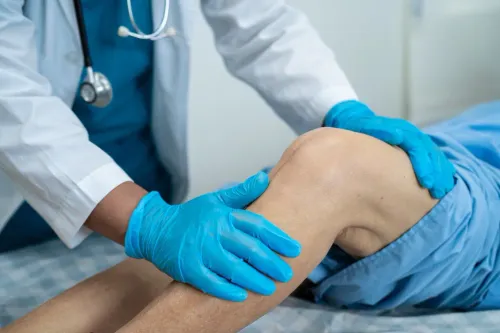
2. The examination includes your gait, leg alignment, knee swelling or effusion, skin temperature, range of motion, strength, ligament stability, tenderness, and ability to fully straighten the knee. The hip and lumbar spine are examined when referred pain is possible.
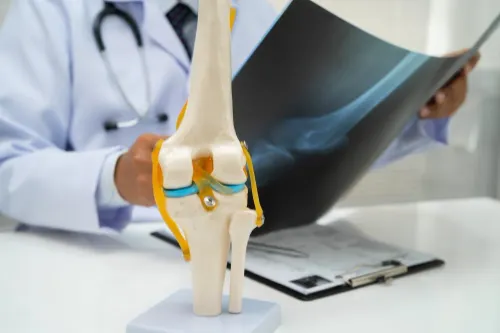
3. If imaging is needed, weight-bearing knee X-rays are usually the first study. They show alignment, joint-space narrowing, and bone changes that an MRI cannot replace for assessing overall joint loading.
4. MRI answers different questions about the menisci, cartilage, ligaments, and other soft tissues. It is often considered after unrevealing X-rays or when a specific internal injury is suspected, not automatically for every knee problem. An MRI meniscus finding alone does not prove that surgery is needed.
5. Ultrasound can assess fluid and selected soft tissues. Blood tests or joint-fluid analysis help investigate inflammatory arthritis, gout, or infection when the history and examination point in those directions.
How to Choose the Right Knee Consultation and Next Step in Swargate
A useful orthopedic consultation ends with a specific next step, not simply “get an MRI” or “try rest.” After examination, the plan should identify whether you need:
- Therapeutic exercise and rehabilitation
- Activity modification
- Weight-management support
- Topical NSAID gel before an oral NSAID, when appropriate
- An injection discussion
- Further tests or referral for a procedure
| Option | What it means | When it applies |
|---|---|---|
| Exercise | Strength, mobility, and supervised rehabilitation | Core treatment for knee osteoarthritis, even if mild initial discomfort occurs |
| Weight management | Support to reduce load on the knee | Any weight loss can help; around 10% often helps more than 5% |
| Injection | Temporary symptom relief | When pain blocks rehabilitation; it is not a cure |
| Procedure referral | Review of surgery or another intervention | True locking, major acute injury, or failed structured non-operative care |
Before taking an oral NSAID, review kidney disease, ulcer history, heart disease, pregnancy, anticoagulants, age, and every other medicine with a clinician. Persistent pain alone does not show that arthroscopic washout will help, and a degenerative meniscus finding on MRI is not automatically an operation indication.
For a knee pain consultation swargate search, Chordiya Clinic offers a local setting to discuss examination findings, scans, medicines, and a structured plan with an orthopedic doctor for knee pain in Pune.
Bring prior scans, medicine names, injury dates, swelling episodes, and a short record of limits involving walking, stairs, sleep, and exercise.
Related service
Consultation Consultation we shall be addressing to your chief complaints and associated health related queries. |
Frequently asked questions
How long should I treat knee pain at home before seeing a doctor?
Arrange a medical evaluation when knee pain lasts more than six weeks, returns after rest, or continues for three months.
When does knee pain need emergency care?
Seek urgent care for a deformed knee, a major injury, sudden severe swelling, inability to bear weight, a hot red knee with fever, or new numbness or weakness.
What can persistent knee pain patterns suggest about the cause?
Pain after activity can point toward overuse or joint wear, locking can indicate an internal joint problem, and pain with swelling after an injury can suggest ligament, meniscus, or bone damage.
What happens during a long-term knee pain evaluation?
The clinician reviews your symptoms, injury history, activity, medicines, and prior treatment, then checks movement, stability, swelling, strength, walking, and tenderness before deciding whether imaging or tests are needed.
How do I choose a knee consultation in Swargate?
Choose a clinic that offers orthopedic assessment, explains the likely cause and next step, reviews existing reports, and provides a clear plan for follow-up or referral.
Keywords