
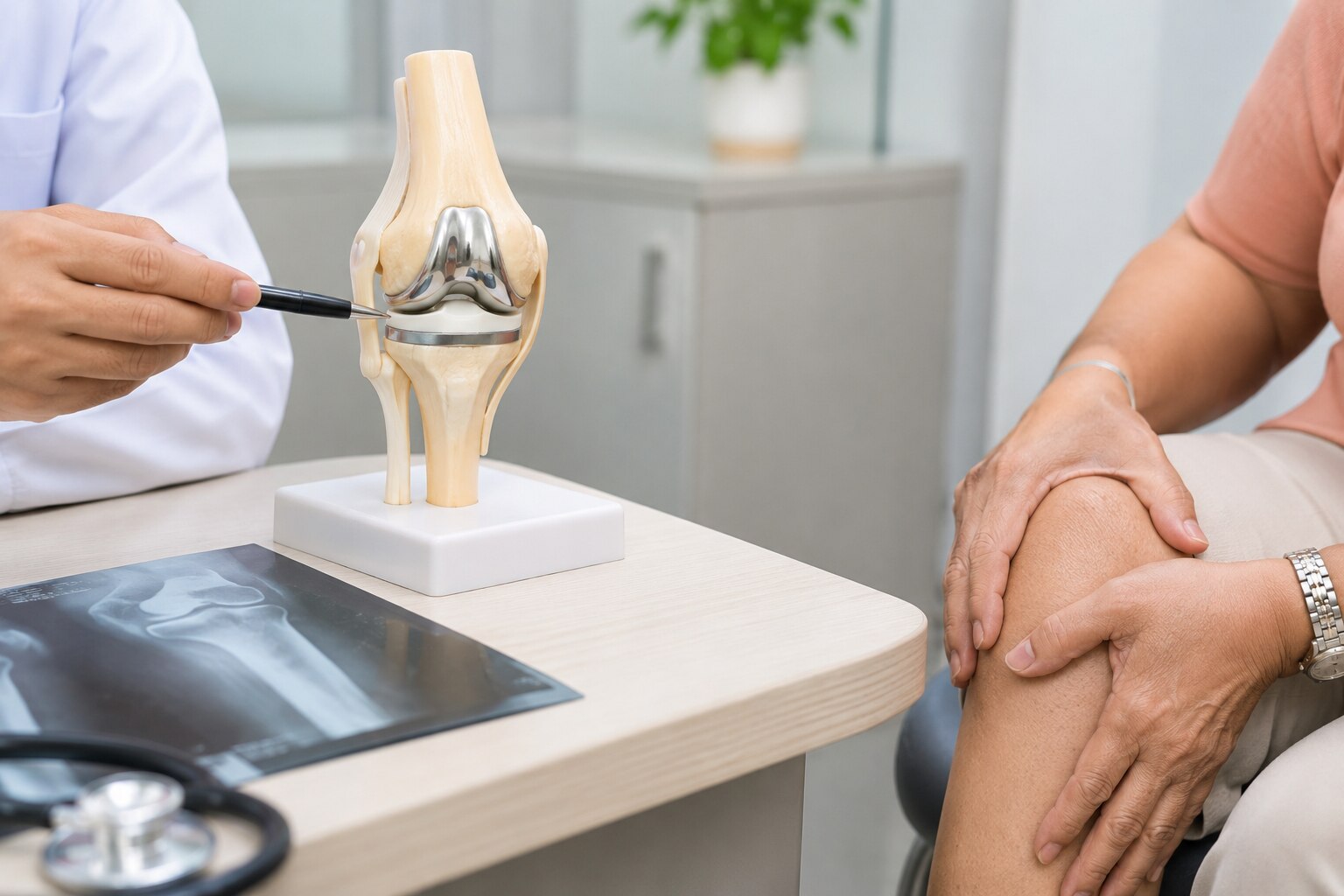
Knee pain becomes a treatment decision when it limits walking, stairs, sleep, work or basic daily tasks. A careful assessment can show whether you need a structured joint-care plan, preparation for surgery, or urgent evaluation for a different knee problem. By the end, you will know what to record, what the consultation involves and which questions to ask before choosing either path.
Key takeaways
- Arrange review when knee pain limits walking, stairs, sleep, work, or daily tasks.
- Compare pain, mobility, health risks, recovery demands, and expected benefits before choosing surgery.
- Bring medication details, previous scans, treatment history, and your activity goals.
- Ask about implant choice, complications, rehabilitation, alternatives, and the surgeon’s experience.
When knee symptoms justify a Bibwewadi consultation
Arrange an orthopaedic assessment when knee pain changes what you can do, not only when an X-ray looks severe. Pain at rest or at night, worsening walking limits, stair difficulty, disturbed sleep, a visible deformity, or trouble managing work and daily tasks all justify review.
Symptoms and X-ray findings can differ, so a decision should consider both.
Book a consultation with a Bibwewadi orthopedic surgeon or orthopedic doctor Bibwewadi residents can access when:
- Pain continues despite exercise, activity changes, suitable medication, or physiotherapy.
- You walk shorter distances, avoid stairs, use a railing, or need a walking aid.
- The knee repeatedly gives way, catches, loses movement, or prevents normal daily activities.
- Pain affects sleep, work, household tasks, or your ability to meet personal goals.
| Symptom pattern | Recommended action | Why it matters |
|---|---|---|
| Persistent pain with declining function | Arrange an orthopaedic assessment | You need examination, gait and movement checks, and usually weight-bearing knee X-rays before choosing ongoing care or discussing replacement. |
| Hot, red, markedly swollen knee with fever or feeling unwell | Seek urgent medical assessment | Infection or inflammatory disease must not be labelled ordinary arthritis without examination. |
| Sudden inability to bear weight, major injury, or a newly locked knee | Seek urgent medical assessment | Fracture, internal injury, or another acute problem may require prompt treatment. |
A consultation does not commit you to knee replacement. Replacement can improve arthritis pain and function, but it is major surgery with risks including infection, clots, stiffness and persistent pain.
How to compare ongoing joint care with knee replacement
Continue non-surgical care when pain remains manageable, walking and daily activities are still practical, knee movement is reasonably preserved, and physiotherapy, strengthening, weight management, medicines or activity changes provide useful relief. Bibwewadi joint care is active treatment, not “doing nothing”.
| Option | Findings that support it | Practical next step |
|---|---|---|
| Ongoing joint care | Symptoms are intermittent or controlled; sleep and work are largely unaffected; examination shows usable movement; weight-bearing X-ray shows mild or moderate arthritis, or imaging does not match the level of disability | Continue exercise-based physiotherapy, suitable pain relief, weight management, activity modification, walking aids or an injection when appropriate; review progress |
| Consider knee replacement | Persistent pain, stiffness or deformity substantially limits walking, stairs, work, sleep or basic activities; examination confirms advanced loss of movement or alignment; weight-bearing X-ray shows severe joint-space loss, bone contact, deformity or extensive osteoarthritis | Discuss expected benefit, risks and rehabilitation in a Bibwewadi knee replacement consultation |
Replacement is supported by the combination, not one finding alone. The symptoms must remain troublesome despite a sustained, appropriately used non-surgical plan, including strengthening and other treatments suited to you. An X-ray showing arthritis without significant pain or functional loss is not enough, and age is not an eligibility cutoff.
Plain weight-bearing knee radiographs are usually the key surgical-planning images. MRI is not routinely needed for typical osteoarthritis unless examination or symptoms suggest another condition.
What happens during the consultation and what to bring
The recommendation starts with your pain and function, not the X-ray alone. In a knee replacement consultation in Pune, an orthopedic doctor Bibwewadi reviews symptom duration, pain location, night or rest pain, walking distance, stair difficulty, sleep, work and daily-activity goals.
The examination includes gait, knee alignment, swelling, tenderness, stability, muscle strength and range of motion.
| Assessment item | What happens or what to bring | Why it matters |
|---|---|---|
| Symptoms and function | Describe walking limits, sleep disruption and activities you cannot manage | Shows the real effect of the knee problem |
| Physical examination | Walk, bend and straighten the knee; the clinician checks alignment and stability | Identifies movement loss, deformity and other pain sources |
| Imaging | Bring previous films and reports; weight-bearing knee X-rays are usually key | Shows joint-space loss and bone changes under load |
| Previous treatment | List physiotherapy, exercise, medicines, steroid or hyaluronic-acid injections and their results | Shows what has been tried and whether benefit lasted |
Bring a current medicine list with doses, including painkillers and drugs for blood pressure, heart, kidney or stomach conditions. Add physiotherapy notes, injection dates, relevant blood-test results and X-ray or MRI reports.
MRI is not routinely needed for typical osteoarthritis, but the clinician may request it when the examination suggests another problem. Ask how each finding affects the choice between continued care and replacement.
Questions to ask before agreeing to knee replacement
Ask these questions before consenting to surgery, and request answers in terms of your walking distance, sleep, work and daily activities—not only your X-ray.
1. What improvement is realistic? Ask how much pain and walking function you expect to regain, and what replacement cannot restore, such as a completely normal knee.
2. Which implant design and materials do you recommend, and why do they suit my age, bone quality, alignment and activity goals? Ask how implant longevity and later revision affect that choice.
3. Will you use spinal, general or combined anaesthesia? Ask about nausea, pain control, nerve blocks and how your heart, lung or other medical conditions change the plan.
4. How long will I stay in hospital, and what must I achieve before discharge? Ask who will help at home and whether you need equipment, transport or home physiotherapy.
5. What rehabilitation schedule will I follow? Clarify exercises, wound care, walking aids, stair practice and the date for review.
6. When can I drive, work, kneel, climb stairs and exercise? Ask which high-impact activities could damage the implant or increase loosening risk.
7. Which complications require urgent attention? Discuss infection, blood clots, stiffness, nerve or blood-vessel injury, persistent pain and revision surgery.
8. What should I do beforehand? Ask about medicines, dental treatment, weight, smoking, blood tests and weight-bearing X-rays; MRI is not routinely needed for typical osteoarthritis. Antibiotics before dental work are not routine solely for a prosthetic knee.
During a Bibwewadi knee replacement consultation, Chordiya Clinic can help you organise these questions around your treatment history and goals. A bibwewadi orthopedic surgeon should also explain whether exercise, medication or injections remain reasonable alternatives; hyaluronic-acid injections are not reliably effective for most people. Use this checklist in any knee replacement consultation in pune.
How to manage the knee if surgery is not the next step
An ongoing plan should treat function, not just the X-ray. Bibwewadi joint care usually combines therapeutic exercise, sensible activity changes, weight management when relevant, pain relief and a scheduled review.
- Work with a physiotherapist on quadriceps and hip strengthening, range-of-motion exercises and suitable aerobic activity. Continue the home programme between appointments.
- Replace painful high-impact activity with cycling, swimming or shorter walking sessions. Use a cane or walker if it improves safety and reduces limping.
- Discuss topical or oral medicines with an orthopedic doctor Bibwewadi. Oral NSAIDs require attention to stomach, kidney, heart and blood-pressure risks; use the lowest effective dose for the shortest appropriate time.
- Consider an injection only after discussing its expected duration, limitations and risks. It should support rehabilitation, not replace it.
- If you are overweight, set a realistic weight-loss target. Any loss can help knee symptoms, with greater loss often bringing greater benefit.
Record pain from 0 to 10, walking distance, stair ability, sleep disruption, exercise tolerance and medicine side effects each week. Bring this record, your medication list and any physiotherapy or injection details to review.
Reassessment is due when the agreed treatment trial fails to improve function, walking becomes harder, night pain increases or daily activities shrink.
Seek urgent medical assessment for a hot, red, markedly swollen knee with fever or feeling unwell, sudden inability to bear weight, a major injury or a newly locked knee.
Frequently asked questions
When should I arrange a Bibwewadi knee replacement consultation?
Arrange an orthopaedic assessment when knee pain limits walking, stairs, sleep, work, or daily activities, or when deformity is visible.
How do I compare ongoing joint care with knee replacement?
Compare your pain and mobility limits with surgery’s recovery, risks, rehabilitation, expected benefits, and available non-surgical options.
What should I bring to a knee replacement consultation in Pune?
Bring previous X-rays or scans, medication and medical-condition details, treatment history, and a list of activities you want to resume.
What questions should I ask before agreeing to knee replacement?
Ask about the diagnosis, alternatives, implant, complications, hospital stay, rehabilitation, recovery timeline, and the surgeon’s experience.
How can I manage my knee if surgery is not the next step?
Follow an agreed plan involving activity changes, strength work, weight management where relevant, pain treatment, and review if symptoms worsen.
Keywords