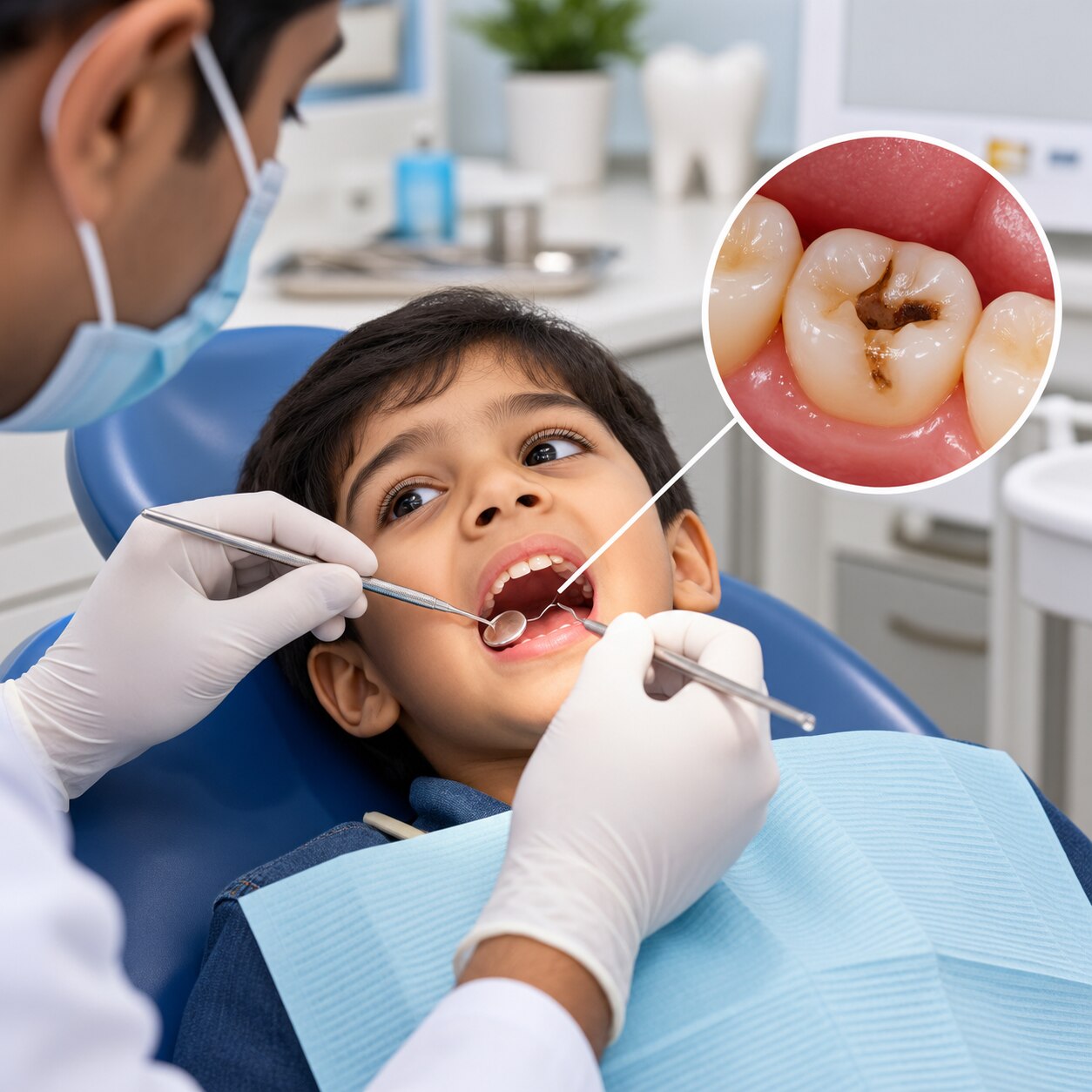
A child can have enamel damage or a developing cavity before complaining of pain. By arranging the right evaluation, you can identify the problem’s depth, understand whether treatment is needed, and know when symptoms require prompt or emergency care.
Key takeaways
- White, brown, or black marks need a dental evaluation, even without pain.
- A visible hole means tooth structure has already been lost.
- Ask what the examination found before comparing cavity treatments.
- Choose a children’s dentist who explains findings and follow-up clearly.
Which Signs Suggest That a Child Has Tooth Decay?
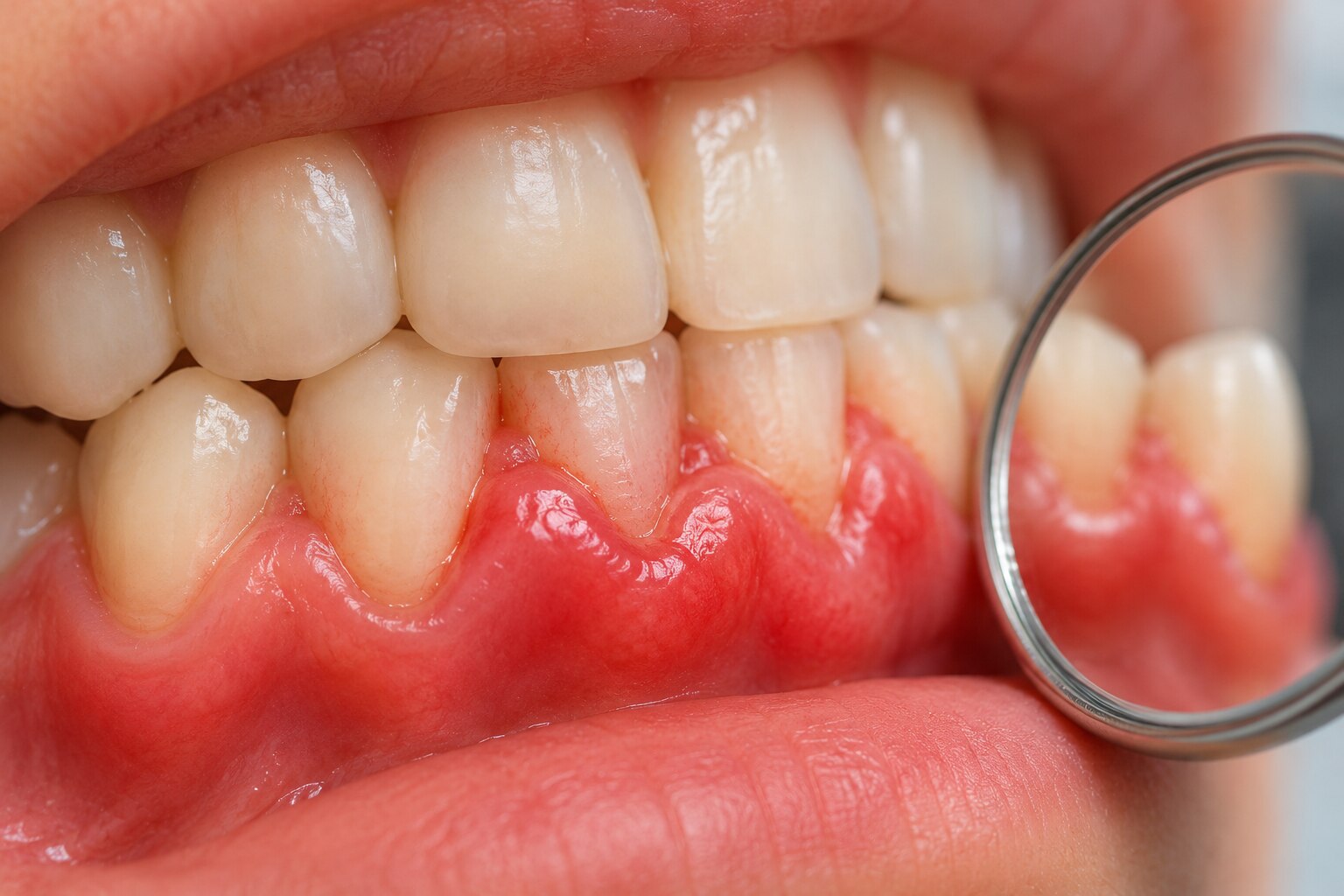
White, brown, or black marks deserve a dental evaluation even when your child feels fine. Early decay can progress beneath the surface or between teeth before pain appears, while a visible hole means tooth structure has already been lost.
| Finding | What it can suggest | What to do |
|---|---|---|
| White, brown, or black spot | Early enamel change or decay | Arrange a child tooth decay consultation |
| Food trapping or a visible hole | A cavity between or within teeth | Book an evaluation promptly |
| Sensitivity, toothache, or difficulty chewing | Deeper decay or a damaged tooth | Seek dental care soon |
| Bad breath, chipped enamel, swelling, or pus | Decay, fracture, or infection | Contact a dentist promptly; facial swelling, fever, trouble swallowing, or breathing needs urgent care |
Frequent sugary drinks, juice, sweetened milk, sticky snacks, and grazing increase acid attacks. Do not put a child to bed with milk or juice; after brushing, offer water. Baby teeth still support eating, speech, sleep, and the position of permanent teeth.
Brush twice daily with an adult supervising. From the first tooth until age 3, use a smear or rice-grain amount of fluoride toothpaste; from ages 3 to 6, use a pea-sized amount. Using too little fluoride toothpaste, allowing swallowing without supervision, or assuming baby teeth need no care increases risk.
Why Evaluate a Cavity When the Child Has No Pain?
Pain is often a late sign, not a safety signal. A chalky white area can indicate early enamel demineralisation, before a hole forms. At this stage, fluoride varnish, better brushing, less frequent sugar, and monitoring may stop or slow progression.
A true cavity has lost tooth structure and often needs restoration. Untreated decay in a baby tooth can lead to infection, pain, poor eating, disturbed sleep, missed school, and difficulty speaking or chewing. Primary teeth also hold space and guide the eruption path of permanent teeth, so extraction is not automatically the simplest choice.
A dentist evaluates the tooth before recommending kids cavity treatment swargate families can compare responsibly:
- The dentist checks the tooth’s location, lesion depth, remaining structure, symptoms, and the child’s risk of further decay.
- An early, non-cavitated lesion may suit observation, fluoride varnish, supervised brushing, and dietary changes.
- A cavitated tooth may need restoration; deeper decay may require pulp treatment.
- A tooth that cannot be restored or has infection may need extraction, followed by assessment for space protection.
- The dentist explains whether preserving the tooth, treating the pulp, removing it, or monitoring it best protects function and the permanent tooth.
An evaluation prevents a painless mark from becoming an emergency and gives you a reasoned plan rather than treatment based only on what you can see.
What Happens During a Child Tooth Decay Consultation?
A thorough child tooth decay consultation starts with history, not a quick visual check. The clinician needs to understand the child’s risk, symptoms, and daily habits before deciding whether a tooth needs monitoring or treatment.
- Record the symptom history, including pain, sensitivity, food trapping, swelling, or chewing difficulty.
- Review previous dental treatment, medical conditions, and fluoride exposure.
- Ask about brushing frequency, toothpaste, plaque control, sugary drinks, and snacks.
- Discuss bottle use, breastfeeding habits, and whether eating, sleeping, or speaking is affected.
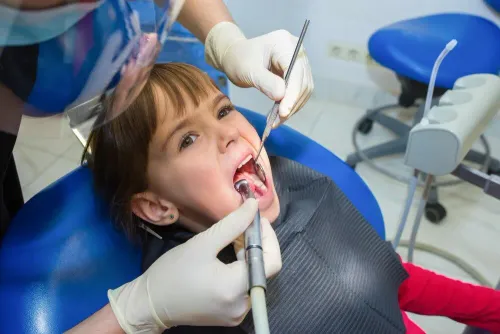
Using a dental mirror and light, the dentist examines every tooth, gum tissue, plaque level, enamel surface, grooves, and spaces between teeth. This can reveal early enamel changes or decay hidden in areas that are difficult to inspect.
Bitewing dental X-rays may be recommended when decay between teeth cannot be seen directly, or when an image will change the treatment decision. Radiographs are not automatic for every child; age, caries risk, clinical findings, cooperation, and likely benefit guide the choice.
The dentist should explain whether each finding is an early non-cavitated lesion or a cavity, how far it extends, and why a proposed treatment suits that tooth. A parent visiting a children cavities dentist in Swargate should leave knowing what was found, what happens if treatment is delayed, and when the child needs review.
Which Treatment Matches the Finding?
The finding, not the size of the visible mark alone, determines kids cavity treatment in Swargate. An early enamel change has different needs from a cavity with missing tooth structure, a painful tooth, or an infection.
| Finding | Likely next step | What parents should know |
|---|---|---|
| Early, non-cavitated enamel change | Fluoride varnish, twice-daily supervised brushing, less frequent sugar, and planned review | Use fluoride toothpaste from the first tooth; an adult should supervise brushing and use a smear or rice-grain amount before age 3, then a pea-sized amount from ages 3 to 6. |
| Small cavitated lesion | Filling or, for selected active cavities, silver diamine fluoride | Silver diamine fluoride can arrest decay without conventional drilling, but it usually turns the decayed area permanently dark and does not rebuild the tooth’s shape. |
| Decay reaching the pulp | Pulp treatment followed by a suitable restoration | Treatment may preserve the tooth when enough healthy structure remains. |
| Unrestorable tooth or infection | Extraction, then assessment for a space maintainer | Removing a baby tooth is not automatically simplest; lost space can affect the eruption path of a permanent tooth. |
Ask how pain will be controlled and how cooperation will be supported. Options include tell-show-do, distraction, desensitisation, nitrous oxide, sedation, or another explained plan; sedation and general anaesthesia require appropriate assessment, consent, monitoring, trained staff, and recovery planning.
A pediatric dentist for cavities in Pune should explain why the chosen option fits that tooth, rather than offering a procedure based only on the visible hole.
How Should Swargate Parents Choose a Children’s Cavities Dentist?
Choose a children cavities dentist in Swargate by the evaluation process, not only by location or the quickest appointment. Compare these points before booking:
| Question to ask | What a strong evaluation includes | Warning sign |
|---|---|---|
| How will my child be examined? | Child-focused communication and examination of every tooth, gum, groove, and space between teeth | Attention limited to the tooth that hurts |
| Is an X-ray needed? | Bitewing radiography when decay between teeth is hidden and the image could change treatment | X-rays offered automatically or refused without explanation |
| What are the choices? | Clear explanation of observation, fluoride treatment, filling, pulp treatment, or extraction | One procedure presented without alternatives |
| How will future decay be reduced? | Brushing, fluoride, diet, and risk-based follow-up advice | Pain relief offered without prevention planning |
Ask whether treatment can be delayed safely, whether the tooth can be preserved, how pain will be controlled, and how fear or poor cooperation will be managed. A suitable pediatric dentist for cavities in Pune will explain what could happen if you wait, including infection or space loss after early extraction.
Arrange a routine appointment for a suspicious mark, food trapping, sensitivity, bad breath, or a painless hole. Seek prompt care for spontaneous or night-time pain, pus, swelling, or fever.
- Treat facial or neck swelling, difficulty swallowing, or difficulty breathing as urgent.
- Consider Chordiya Clinic when its pediatric dental consultation follows this clear process rather than relying only on symptom relief; less pain or a better-looking tooth does not prove the decay is gone.
Related service
Consultation Consultation we shall be addressing to your chief complaints and associated health related queries. |
Frequently asked questions
Which signs suggest that a child has tooth decay?
White, brown, or black marks, a visible hole, food trapping, sensitivity, or changes between teeth can indicate decay. A dentist must examine the tooth to confirm the cause.
Why evaluate a cavity when the child has no pain?
Decay can progress beneath the enamel or between teeth before pain begins. A visible hole shows that tooth structure has already been lost.
What happens during a child tooth decay consultation?
The dentist examines the teeth and gums, checks suspicious marks and areas between teeth, asks about symptoms and eating habits, and recommends imaging when the finding cannot be assessed visually.
Which treatment matches a child’s cavity finding?
Treatment depends on whether the area is an early enamel change, a cavity with lost tooth structure, or decay close to the pulp. Options can include monitoring with prevention, fluoride treatment, a filling, a stainless steel crown, or pulp treatment.
How should Swargate parents choose a children’s cavities dentist?
Choose a dentist who regularly treats children, explains the diagnosis and alternatives, discusses behaviour guidance, gives a prevention plan, and provides clear follow-up instructions.
Keywords