
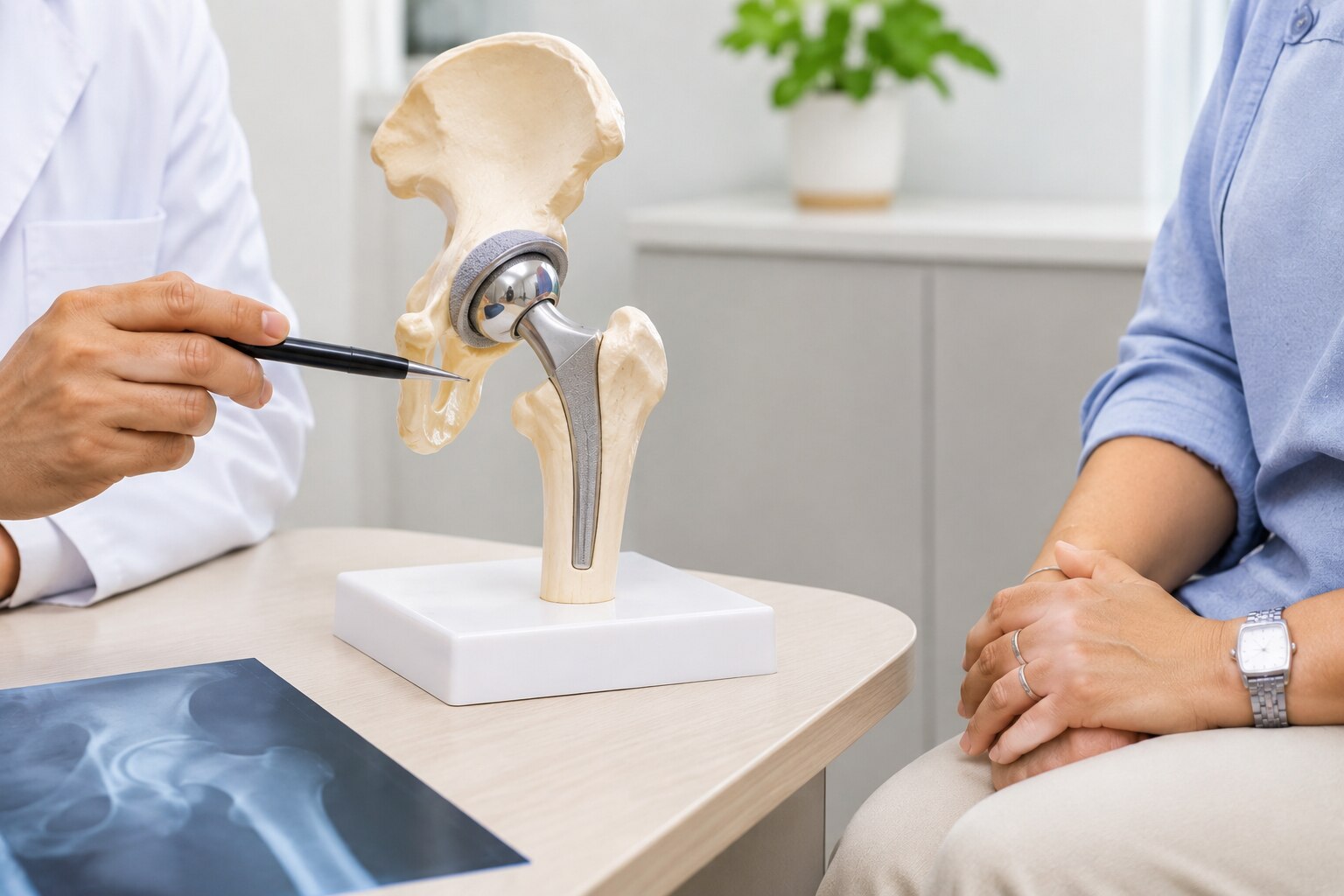
Pain while walking, limping, difficulty climbing stairs, or trouble putting on footwear does not automatically mean that hip replacement is the right answer. A careful assessment helps identify the true source of restricted movement, compare non-surgical and surgical choices, and set realistic expectations for rehabilitation and joint care.
Key takeaways
- Match pain patterns with gait and hip movement before blaming the joint.
- Use examination findings and X-rays together to assess hip-related mobility problems.
- Compare non-surgical care with hip replacement before choosing surgery.
- Plan rehabilitation, walking support and follow-up before the operation.
How the consultation connects your symptoms to mobility problems
A consultation determines whether the hip joint is causing your walking difficulty by matching your pain pattern with gait, hip movement, examination findings and imaging. An X-ray alone cannot prove that the hip is responsible.
Your clinician will ask when pain starts, where you feel it and which movements have become difficult. The following clues help connect symptoms to the joint:
- Groin pain while walking or standing
- Limping or shorter walking distance
- Difficulty climbing stairs or rising from a chair
- Reduced hip rotation or trouble putting on socks and footwear
The examination also checks whether moving the hip reproduces your pain, whether the joint has lost range of motion and whether your leg length or walking pattern has changed. These findings can distinguish hip arthritis from pain referred from the back, knee or surrounding soft tissues.
If your symptoms do not match the hip findings, the clinician may investigate lumbar spine disease, bursitis, tendon problems or referred knee pain instead. Treating the wrong source will not restore your walking ability, even if the hip X-ray looks worn.
For someone considering a hip replacement consultation for Mukundnagar, explain the mobility matters most to you: walking to work, using stairs, standing from a chair or managing household tasks. The recommendation should connect a confirmed hip problem with a realistic improvement in those activities, not promise to correct every cause of limping or weakness.
What the examination, records and X-rays reveal
An orthopedic doctor in Mukundnagar will review your symptoms, walking limits and previous treatment before interpreting the X-rays. Expect questions about pain while walking, stair use, limping, standing from a chair, reduced hip rotation and difficulty putting on footwear.
The examination includes gait observation, hip range-of-motion testing, leg-length assessment and checks for weakness or pain from the spine, knee or other tissues.
Bring information that can change the diagnosis, surgical risk or rehabilitation plan:
- Current medicines, allergies and pain treatments, including injections.
- Previous X-rays, MRI scans, blood-test results and consultation reports.
- Details of diabetes, obesity, anaemia, heart or lung disease, smoking and previous blood clots.
- Your surgical history, walking-aid use and activities you need to resume.
- Your preferred activity level, including walking, cycling, swimming, work demands or sport.
The doctor may discuss a standing anteroposterior pelvis and hip X-ray. Compare the evidence this way:
| Information | What it reveals | Why it matters |
|---|---|---|
| Standing X-ray | Joint-space loss, bone changes, deformity or wear | Shows how the hip bears weight |
| MRI scan | Cartilage, soft tissues or early bone problems | Helps when X-rays do not explain symptoms |
| Physical examination | Motion limits, gait changes and pain location | Tests whether imaging matches your mobility problem |
| Medical records | Health risks and previous treatment response | Supports safer planning and realistic joint care |
Ask about implant longevity, permitted activities and revision risk. A damaged-looking X-ray alone does not decide treatment; your mobility goals and examination findings must fit the picture.
Which treatments should you compare before hip replacement
Compare each option against your pain, walking distance, sleep, hip damage and health—not the X-ray alone. Hip replacement becomes more relevant when pain, stiffness or loss of function limits stairs, dressing or sleep and joint care has not provided enough relief.
| Option | What it means | When it applies |
|---|---|---|
| Non-surgical care | Physiotherapy, strength work, weight management, walking aids and pain medicine; it does not restore worn cartilage. | Start here for mild or moderate symptoms, or when surgery risk is high. |
| Injections | A corticosteroid injection can reduce inflammation and pain for a limited period, but it does not rebuild the joint. | Useful for temporary relief or when you need clearer evidence that the hip is causing symptoms. |
| Hip-preserving procedures | Arthroscopy, osteotomy or correction of structural problems aims to retain the natural hip. | Consider for selected patients with impingement, labral damage, dysplasia or early arthritis; advanced arthritis makes these procedures less suitable. |
| Observation | Track symptoms, walking ability and imaging while delaying intervention. | Reasonable when pain is manageable and daily function remains acceptable; worsening mobility needs review. |
| Hip replacement | The damaged joint surfaces are replaced with an artificial ball and socket, followed by rehabilitation. | Consider when symptoms persist despite appropriate non-surgical treatment and the expected mobility gain outweighs surgical risks. |
Ask which diagnosis supports each choice, what improvement is realistic, and what happens if you wait six or twelve months. Discuss injection timing, recovery demands and the activity limits that will shape your long-term joint care.
How a doctor decides whether hip replacement is suitable
Severe pain, marked stiffness and loss of function support hip replacement only when the hip joint is the confirmed source. The doctor matches groin or thigh pain, limping, stair difficulty, reduced rotation and trouble standing or wearing footwear with examination findings and standing pelvis and hip X-rays.
Back disease, bursitis or tendon problems can produce similar symptoms.
| Factor | What the doctor assesses | Why it changes the recommendation |
|---|---|---|
| Symptoms | Pain at rest or during walking, night pain and reduced daily activity | Surgery becomes more reasonable when pain persists despite appropriate treatment |
| Joint findings | Cartilage loss, bone damage, deformity, restricted movement and gait change | Imaging must match symptoms; an abnormal X-ray alone is not enough |
| Health conditions | Diabetes control, heart or lung disease, obesity, infection, medicines and previous operations | These affect anaesthesia, wound healing, clot risk and surgical timing |
| Personal goals and risks | Desired walking distance, work, sport, implant longevity and willingness to rehabilitate | A younger or highly active person faces more lifetime wear and revision exposure |
For a hip replacement consultation for Mukundnagar, ask what improvement is realistic and which non-surgical options remain. An orthopedic doctor in Mukundnagar should also explain infection, blood clots, dislocation, fracture, nerve or blood-vessel injury, leg-length difference and revision risk. Chordiya Clinic can help organise these questions around your medical records and mobility goals.
Active infection needs treatment before surgery, while routine dental antibiotic cover is not automatic; coordinate it only if your dental and orthopaedic teams identify a specific reason.
Related service
Consultation Consultation we shall be addressing to your chief complaints and associated health related queries. |
How consultation planning supports recovery and lasting mobility
Expect assisted transfers, a walker or crutches, wound care and prescribed exercises soon after hip replacement. Pain and swelling usually limit movement at first, so mobility matters before surgery: very poor walking ability can mean more help at home even when the implant works well.
Use the consultation to build a practical plan for rehabilitation, including:
- Who will help with bathing, meals, stairs and transport?
- How will you progress from transfers to walking, strengthening and fall prevention?
- When can you drive, return to work, climb stairs or travel?
- Which approach and implant are proposed, and what improvement is realistic?
- Which activities are encouraged, and which involve excessive impact or repetitive jumping?
- How long might rehabilitation take, and when should you seek review?
Recovery plans differ by health, muscle strength and home layout. This comparison gives you a framework to discuss with the surgical team.
| Stage | What to expect | Planning question |
|---|---|---|
| Early recovery | Assisted walking, exercises and gradual weight-bearing | Will I need a walker, home physiotherapy or overnight help? |
| Building function | Longer walks and strengthening as pain and balance improve | What milestones should I reach before driving or working? |
| Long-term activity | Walking, swimming and cycling are commonly suitable after recovery; impact limits are individual | Which activities protect joint care and reduce implant stress? |
Ask which symptoms require urgent review, including fever, wound drainage, increasing calf swelling, sudden breathlessness, new severe pain or inability to bear weight. Discuss infection, clots, dislocation, leg-length difference and revision risk, plus how long the implant is expected to last.
Persistent pain can also come from the back, muscles or nerves, not only the replaced joint.
Frequently asked questions
How does a hip replacement consultation connect symptoms to mobility problems?
The doctor compares your pain pattern with your gait, hip movement and examination findings to assess whether the hip is causing difficulty walking.
What do examination records and X-rays reveal?
They show how the hip moves, where symptoms arise and whether imaging changes match your mobility problems. An X-ray alone cannot prove the hip is responsible.
Which treatments should you compare before hip replacement?
Compare non-surgical care with hip replacement, considering how symptoms affect walking, examination findings, imaging and your response to earlier treatment.
How does a doctor decide whether hip replacement is suitable?
The decision combines your symptoms, functional limitations, examination findings, X-rays, previous treatment and readiness for rehabilitation.
How does consultation planning support recovery and lasting mobility?
Planning identifies rehabilitation needs, walking support, follow-up arrangements and practical steps to protect mobility after surgery.
Keywords