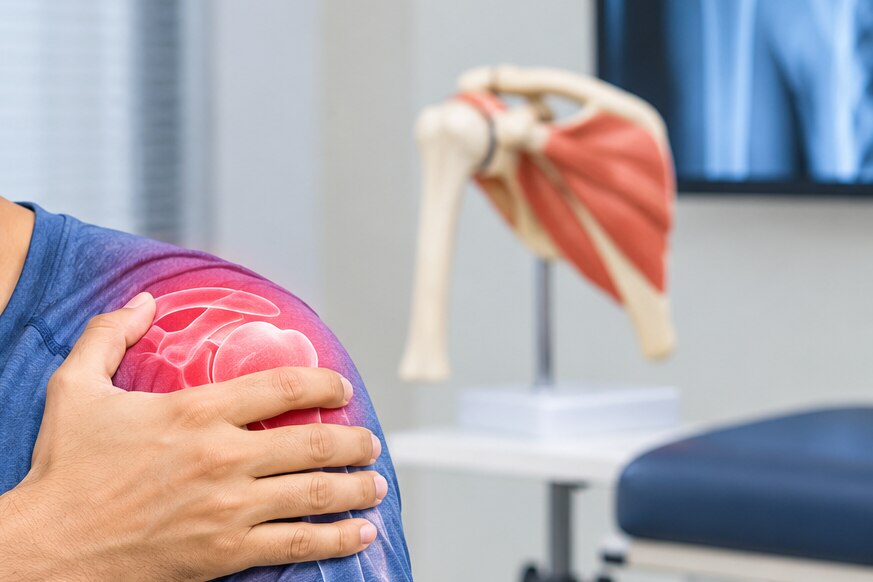

Shoulder pain can come from the shoulder joint, tendons, neck nerves, heart, or lungs, and the right next step depends on its pattern and severity. Use the warning signs, preparation checklist, examination details, and treatment trade-offs below to decide between emergency care, prompt orthopedic assessment, physiotherapy, and monitored self-care.
Key takeaways
- Seek emergency care for shoulder pain with chest pressure, breathlessness, sweating, or nausea.
- Book urgent review after a fall, deformity, sudden weakness, or inability to move your arm.
- Match pain patterns with an examination rather than relying on symptoms alone.
- Take medication details, injury history, and prior scans to your consultation.
When shoulder pain needs emergency care, urgent review, or a planned evaluation
Chest pressure, shortness of breath, sweating, nausea, or pain spreading to your jaw or arm requires emergency care, not a scheduled shoulder appointment. A shoulder pain orthopedic doctor in Swargate is not the correct first destination when heart or lung pain is possible.
Go to an emergency department immediately for:
- A visibly deformed shoulder
- Sudden inability to lift the arm after a fall, forceful lift, or dislocation-type injury
- A cold, pale, blue, or persistently numb hand
- Severe pain after an injury, especially with marked swelling or loss of movement
Arrange prompt in-person assessment for shoulder pain with fever, redness, warmth, rapidly increasing swelling, or feeling unwell. Seek the same urgency after recent shoulder surgery, an injection, or an open wound, and if you have immune suppression.
A routine orthopedic evaluation fits pain that lasts beyond a short period, keeps returning, causes worsening weakness or stiffness, or follows recurrent dislocation. A physiotherapy assessment can help after fracture, dislocation, infection, and major tendon injury have been excluded; do not exercise through escalating pain or weakness.
Children and adolescents need age-appropriate review after sports, throwing, or falls because growth-plate injuries and instability differ from adult shoulder disease. If symptoms are settling after medical clearance, graded physiotherapy may be appropriate.
What different shoulder pain patterns can suggest
Painful lifting, night pain, and weakness often occur with rotator-cuff tendinopathy or a tear. Sudden inability to raise the arm after a fall or forceful lift raises concern for a tear, fracture, or dislocation and needs prompt assessment rather than self-diagnosis.
Use these patterns as information to report, not as a diagnosis:
- Frozen shoulder develops over months and restricts both active and passive movement, especially external rotation. Diabetes is an important associated condition.
- A dislocation or fracture usually follows an injury and may cause deformity, marked swelling, or immediate loss of function.
- Osteoarthritis causes activity-related pain and stiffness that may ease with rest.
- Rheumatoid arthritis causes inflammatory pain, swelling, and stiffness, sometimes affecting more than one joint.
- Bursitis can make compression and overhead movement painful, including lying on the affected side.
Pain from cervical nerve compression can travel from the neck into the shoulder or arm with tingling, numbness, or weakness. A shoulder mobility problems doctor must examine your neck, reflexes, sensation, and arm strength instead of assuming the shoulder is the source.
Shoulder pain is not always caused by the shoulder: heart or lung disease can refer pain there, especially with chest pressure, breathlessness, sweating, or nausea. Pain relief does not prove a diagnosis, and a normal X-ray does not exclude tendon disease; examination and, when needed, ultrasound or MRI provide different information.
What happens during a proper shoulder evaluation
A proper shoulder evaluation starts with a detailed history, not an immediate scan. The clinician should ask when symptoms began, how an injury happened, which movements hurt, whether pain wakes you, and whether you have weakness, stiffness, swelling, numbness, or previous treatment. Mention diabetes, rheumatoid arthritis, immune suppression, and other relevant conditions.
The examination should include:
- Inspection for deformity, muscle wasting, bruising, or swelling.
- Active movement, followed by passive movement, including elevation and external rotation.
- Strength testing and shoulder-specific manoeuvres for the rotator cuff, biceps, and instability.
- Examination of the neck, reflexes, sensation, and arm strength to detect nerve-root problems.
The movement pattern provides an important clue. Painful or weak active movement with better passive movement points toward weakness or tendon disease. Restriction of both active and passive movement, especially external rotation, points more toward joint stiffness such as frozen shoulder.
A shoulder mobility problems doctor should measure this difference rather than rely only on your pain score.
For a shoulder pain consultation in Swargate, ask why each scan is needed. X-rays show fractures, arthritis, dislocation, and calcific deposits; ultrasound assesses rotator-cuff and biceps problems; MRI helps assess suspected tendon or labral injury when the result will change treatment. Ultrasound depends on operator skill, while MRI findings need clinical correlation.
A normal X-ray does not exclude tendon disease, and an abnormal scan does not automatically identify the pain source.
How to prepare and what treatment decisions may follow
Record these details before a shoulder pain consultation in Swargate:
- When symptoms began and what caused them
- Which movements hurt, and whether pain wakes you
- Weakness, stiffness, swelling, or numbness
- Previous treatment and relevant conditions, including diabetes or rheumatoid arthritis
Bring previous X-rays, MRI reports and images, prescriptions, injury records, and a current medicine list. Routine orthopedic consultations do not usually require fasting; confirm the clinic’s instructions if a procedure is planned afterward.
Ask:
- What is the likely diagnosis?
- Which tests are needed, and how will results change treatment?
- What alternatives are available?
- What recovery timeline and activity restrictions should I expect?
- Which warning signs require earlier help, and when should I return?
While waiting, use relative rest and avoid painful overhead loading. Apply ice after a recent injury; use heat for comfortable stiffness. Follow medicine-label directions only after checking contraindications with a clinician or pharmacist. Do not force severe stiffness, repeatedly massage an acute injury, self-inject steroids, or keep the arm in a sling for prolonged periods.
| Option | Purpose and trade-off | Rehabilitation, recovery, and cost |
|---|---|---|
| Medicines | Reduce pain; do not correct structural damage | Usually least rehabilitation and cost; risks depend on the drug |
| Physiotherapy | Restore movement, strength, and function | Requires consistent exercises; recovery takes weeks or months |
| Steroid injection | Short-term pain reduction in selected conditions | Limited rehabilitation benefit; does not repair a tendon or replace exercise |
| Surgery | Repair or reconstruct a confirmed problem | Highest cost and rehabilitation time; recovery depends on the procedure |
How to compare shoulder-care options in Swargate and Pune
A shoulder pain orthopedic doctor in Swargate should examine more than the painful joint. Choose a provider who checks the neck, nerves, strength, and range of motion, then explains whether imaging will change treatment.
| Provider feature | What to verify | Why it matters |
|---|---|---|
| Shoulder experience | Shoulder-specific examination and injury assessment | Hip and knee replacement expertise does not answer shoulder questions |
| Imaging access | X-ray, ultrasound, or MRI arrangements | Each test answers different clinical questions |
| Non-surgical planning | Activity modification, medication advice, injections, and physiotherapy options | Surgery is not the default |
| Physiotherapy coordination | A referral or communication process with a physiotherapist | Exercises need adjustment for weakness or stiffness |
| Surgical referral criteria | Specific findings that would justify referral | You avoid unnecessary procedures |
An orthopedic doctor for shoulder pain in Pune can evaluate you without recommending surgery. Shoulder arthroscopy is a later procedure for selected tendon, labral, or joint problems, not the automatic result of an initial consultation. Use examination findings and symptom progression, not a search label or scan alone, to choose the next step.
Before booking a shoulder pain consultation Swargate at Chordiya Clinic, verify:
- The Swargate address, booking method, consultation duration, and accessibility
- The follow-up process and available imaging arrangements
- Whether physiotherapy coordination is offered
Emergency symptoms require emergency care. Injury with weakness or deformity needs prompt assessment. Persistent or recurrent symptoms merit orthopedic review. After medical clearance, uncomplicated recovery can proceed with graded physiotherapy.
Related service
Consultation Consultation we shall be addressing to your chief complaints and associated health related queries. |
Frequently asked questions
When does shoulder pain require emergency care?
Seek emergency care for shoulder pain with chest pressure, shortness of breath, sweating, nausea, or pain spreading to your jaw or arm. Get urgent review after a major injury, visible deformity, sudden weakness, or inability to move the arm.
What can different shoulder pain patterns suggest?
Pain after an injury can point to a fracture, dislocation, or tendon damage. Pain during overhead movement can involve the rotator cuff or shoulder impingement. Night pain, stiffness, or gradually reduced movement can indicate a different shoulder problem and needs examination.
What happens during a shoulder pain consultation in Swargate?
The doctor reviews your symptoms, injury history, work and activity demands, medicines, and previous scans. The examination checks tenderness, range of motion, strength, sensation, circulation, and neck-related causes before deciding whether imaging is needed.
How should you prepare for a shoulder evaluation?
Bring previous X-rays or MRI reports, a list of medicines, details of when symptoms began, and information about injuries or repetitive activities. Wear clothing that allows the clinician to examine your shoulder and upper arm.
How do you compare shoulder-care options in Swargate and Pune?
Compare appointment access, clinician expertise, examination quality, imaging referrals, follow-up arrangements, physiotherapy coordination, and clarity about treatment choices. Choose emergency care instead of a routine clinic when warning signs are present.
Keywords